At a glance
App name
iTalki

Made by
italki HK Limited
Pricing, free trial, refunds

First-hand review
Intro
Hey everyone! In today’s video, I’m going to talk about iTalki — one of the most popular platforms for learning languages online. If you’ve ever wanted to improve your Italian by actually talking with native speakers, you’ve probably heard of it. So, I decided to give it a try and see how it really works — what I liked, what could be better, and who it’s best for.
What iTalki Is
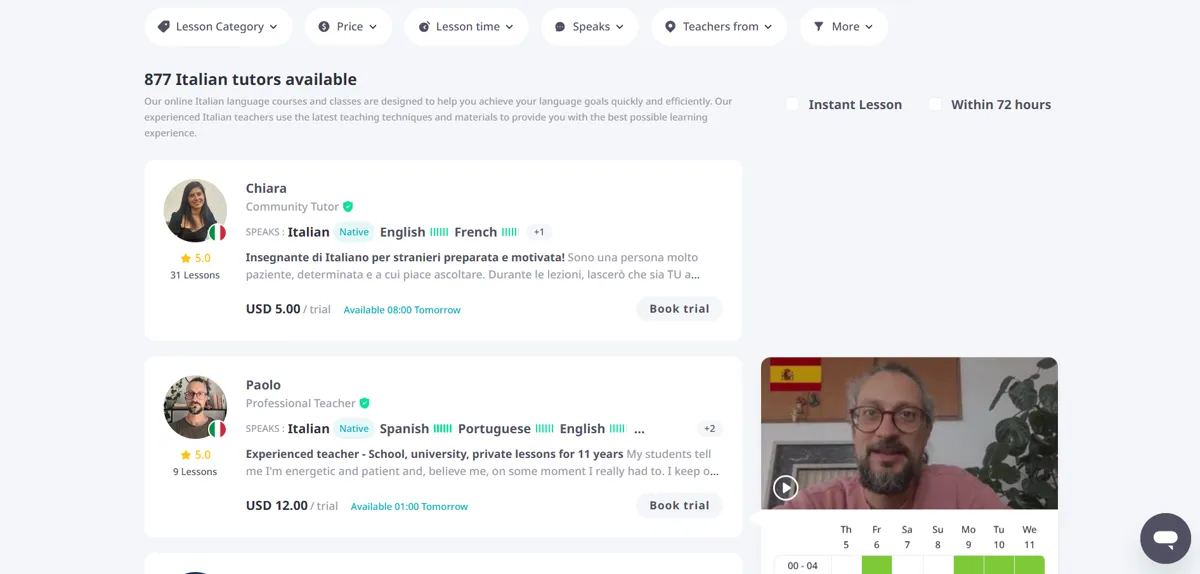
Basically, iTalki is a marketplace for one-on-one language lessons. It connects students like me with tutors from all over the world who teach Italian online. You could think of it like Airbnb, but instead of renting apartments, you’re booking time with a language teacher. The platform itself doesn’t teach — it just connects you to independent teachers who use it to offer lessons. And the variety is huge: there are hundreds of Italian tutors, all with different prices, backgrounds, and teaching styles.
How It Works
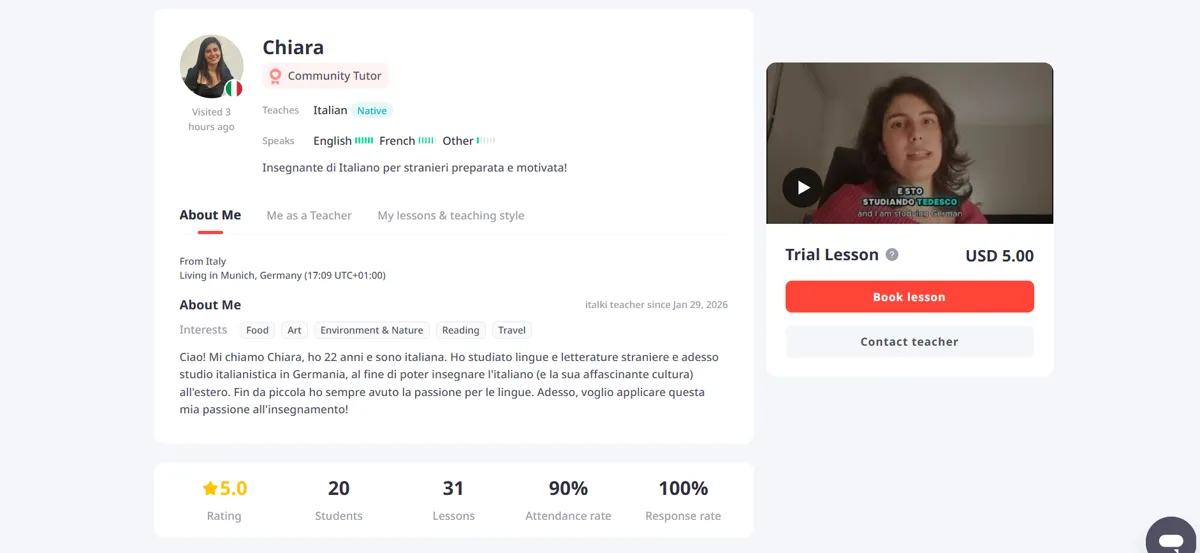
Setting up an account was pretty simple — I just created a profile, selected Italian as the language I wanted to learn, and started browsing tutors. Each teacher has a profile with a short video introduction, their hourly rate, ratings from other students, and a calendar that automatically adjusts to my time zone. I was able to filter tutors by things like native language, country, teaching experience, and even what kind of lessons they offer — grammar, conversation, or test prep. Once I found a few tutors I liked, I booked some trial lessons. Most of them offer short 30-minute trials for half price or even less, which makes it easy to test the waters before committing. The lessons themselves happen through video chat — usually via the iTalki Classroom, Zoom, or Skype. It’s all very flexible: I could choose the time, platform, and focus of each session.
Types of Teachers
On iTalki, there are two main types of teachers: Professional Teachers and Community Tutors. Professional teachers usually have teaching certificates, degrees, or experience working at language schools. Their lessons tend to be more structured, with materials and grammar explanations. Community tutors, on the other hand, are native speakers or fluent Italian speakers who focus more on conversation and informal practice. Personally, I found that trying both was helpful — professional teachers were great when I wanted to review grammar, while community tutors helped me get more comfortable speaking naturally.
My Experience
When I first started, I wanted to improve my conversational Italian. So I booked three different tutors — one from Rome, one from Milan, and one from Naples — just to hear different accents and see which one felt like the best fit. The first few lessons were a bit slow, but after a couple of sessions, I noticed I was picking up expressions I’d never seen in textbooks. Some teachers corrected every little mistake; others waited until the end of the conversation to give feedback. It really depends on the person, so it took a bit of trial and error to find my rhythm. One thing I appreciated was how easy it was to reschedule or cancel lessons — everything’s built right into the app. And since I could pay in advance using iTalki credits, I didn’t have to deal with separate payments for every class.
Community Features
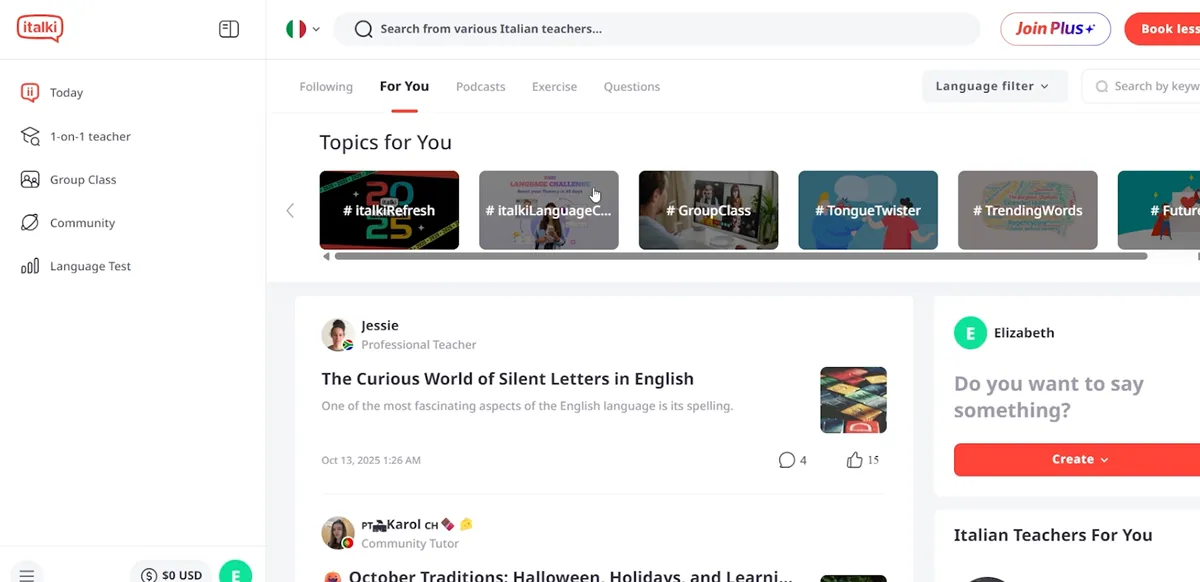
Beyond the paid lessons, iTalki has a “Community” section inside the app that’s actually pretty cool. You can post short texts in Italian to get corrections from native speakers, ask grammar questions, or even record yourself speaking to get pronunciation feedback. There’s also a place to look for free language-exchange partners — basically, someone who wants to learn your language while helping you practice Italian. It’s not as organized as it used to be, but I still found it a nice bonus if you want to practice without booking a class.
Pricing
Prices on iTalki vary a lot. For Italian, I saw tutors charging anywhere from 8 to 30 dollars per hour, depending on experience and where they’re from. Trial lessons are cheaper, and many teachers offer discounts for buying lesson packages. You can pay with credits that stay in your account — just be aware that there’s a small processing fee, and unused credits expire if you don’t log in for a year. Overall, it’s still one of the most affordable ways to get private lessons with native Italian teachers, especially compared to language schools.
Pros
So, what did I like the most? First, the flexibility. I could schedule lessons whenever I wanted and choose teachers who matched my level and goals. Second, the variety — there are so many Italian tutors to choose from that it’s almost impossible not to find someone who clicks with you. Third, the personalization. Since it’s one-on-one, every lesson can be completely tailored to your needs — grammar, conversation, pronunciation, or even business Italian. And lastly, it’s surprisingly affordable for private tutoring.
Cons
Now, there are a few things that could be improved. Because there are so many tutors, the quality can vary a lot. You might need to try several before finding one that fits your learning style. Also, scheduling each class manually can make it easy to skip lessons if you’re not disciplined. The community features are only on the app, not on the desktop version, which can be a bit inconvenient. And finally, the processing fees add up if you buy credits often. Nothing major, but good to keep in mind if you plan to use it long-term.
Who It’s Best For
In my opinion, iTalki is perfect for anyone who wants to speak Italian more confidently — especially if you already know some basics and want real interaction with native speakers. If you prefer a flexible schedule and like the idea of customizing your lessons, it’s a great fit. But if you’re the type who needs a structured program with clear levels and homework built in, you might find iTalki a little too open-ended.
My background on italki
I signed up on italki in 2010 as a learner. In my original italki review, from 2020, I counted 400+ classes taken there, all in other languages: Korean, Mandarin, German, Brazilian Portuguese, Russian, Indonesian, Turkish, Cantonese and Romanian. I applied for a teaching account in 2016, and online tutoring became my main source of income. By 2020 I had taught 1,400+ Italian classes, one student alone had taken 350+ lessons with me, my profile had a 5/5 rating, and italki chose me to shoot a professional profile video that is used as a model for new tutors. So I see italki from both sides, as a student and as a tutor.
Why live lessons, and why one-to-one
Speaking is the skill that self-study covers worst. For reading, grammar or listening you can pick up a textbook or an app, and for writing you only need pen and paper. For speaking you need someone to talk to. If you have the time and the money, I recommend one-to-one lessons with a native tutor and treating every course or app as a supplement. In a one-to-one lesson it is only you and the tutor, so most of the time goes to you speaking while the tutor corrects your mistakes and keeps the conversation alive. Group classes cost less, but the time is split between students and you often end up listening. Lessons online also save the commute and the noisy cafe, and that saving is one reason online tutors can charge less.
How I choose a tutor
The three things I look at on a tutor’s profile are the intro video, the teaching style and the students’ written reviews. Filters let you narrow the list by native or non-native speaker, price, languages spoken, country and availability. I recommend a native speaker even for a total beginner, and I would pay for a professional teacher for at least the first few months. Use the discounted trial lessons to compare a few tutors, then ask the one you like about a package, which many tutors discount. 60 minutes is the usual lesson length and some tutors also offer 30, 45 or 90 minutes. If you are a beginner, frequent short sessions can work better than a long weekly one.
Free language exchange
When I reviewed italki in 2020, the free language-exchange search under Community could work for intermediate speakers. For beginners I found it a waste of time: you spend hours looking for partners, and many are not motivated or do not know how to teach their own language. Beginners need a teacher first.
What I don’t like about italki
Star ratings mean very little. When I checked in 2020, 95% of active tutors had a rating of 4.9/5 or above. People find it awkward to leave a bad review right after direct contact, a bad trial lesson could not be rated, and unhappy students leave after one lesson while happy ones keep taking and rating classes. So I read the written reviews, watch the intro video and try a trial lesson instead of trusting the stars.
Instant lessons are back, with limits. In 2020 I criticised italki for dropping instant tutoring, the feature that found you a teacher who could start within 10 minutes. italki now offers Instant Lessons again: you filter for teachers available now and buy a 30, 45 or 60-minute trial lesson that starts 5 minutes later in the italki Classroom. Instant Lessons cannot be cancelled or rescheduled.
The virtual classroom. In 2020 the italki classroom never worked properly for me, so I studied and taught on Skype. italki has rebuilt it since: it runs in the browser and in the mobile app, with chat, screen sharing and a microphone and camera check before each lesson, and Instant Lessons have to be taken in it. italki also lists Zoom, Skype and Google Meet as video options for regular lessons. Test the classroom in a trial lesson before you rely on it.
Support and community. Support is not always helpful. In September 2020 italki also removed the free Notebook, where other members corrected your writing. italki’s 2026 description of the platform still lists writing corrections and discussion forums under Community.
Price and payment details
You do not need a subscription: you buy italki Credits and pay for each lesson or package, and each tutor sets their own price. When I surveyed Italian tutors in 2020, rates ran from about $4 to $31 an hour, with decent conversation practice usually at $10-15 and a structured lesson with a professional teacher at $15-25. italki’s own rules now set a minimum of $5 per lesson for community tutors and $10 for professional teachers, and its 2026 price guide gives $4-25 as the typical range. Trial lessons are usually 30 minutes and discounted by 30-50%, and you get up to 3 of them, each with a different teacher, with a 100% satisfaction guarantee up to 2 times.
Credits are charged in USD. Any processing fee comes from the payment provider, not from italki, and is shown before you pay. A lesson can be cancelled or rescheduled only more than 24 hours before it starts, and credits expire after 12 months without logging in. The tutor is paid after you confirm the lesson took place, and a Lesson incomplete button lets you propose a refund within 72 hours.
For tutors: what italki keeps
In 2020 I wrote that italki took a flat 15% of the lesson fee, which I called low for the industry. That is no longer true. italki’s help center (updated September 2026) lists 0% on trial lessons, 21% on single lessons, 19% on a 5-lesson package, 17% on a 10-lesson package, 15% on 15- and 20-lesson packages and 30% on group classes. Most of my criticism of italki as a tutor was about teaching rather than learning, so I do not cover it here. My guide to teaching on italki goes into it.
italki compared with other options
In 2020 I named Verbling as the only alternative worth trying: a similar scheduling system with a smaller pool of teachers. Verbling still runs and lists Italian tutors. At the time I advised against Preply because of its interface, its small teacher database and its commissions. I have since reviewed it separately, so read my Preply review before you decide. On commission the gap has narrowed: Preply keeps 100% of the first lesson with each new student and 18-33% afterwards, while italki keeps 0% of trial lessons and 15-21% of regular ones. For a learner the practical difference is billing: italki is pay-per-lesson, so you can stop whenever you like.
Outro
So overall, my experience with iTalki was positive. It’s flexible, affordable, and it gives you direct access to native Italian speakers from wherever you are.